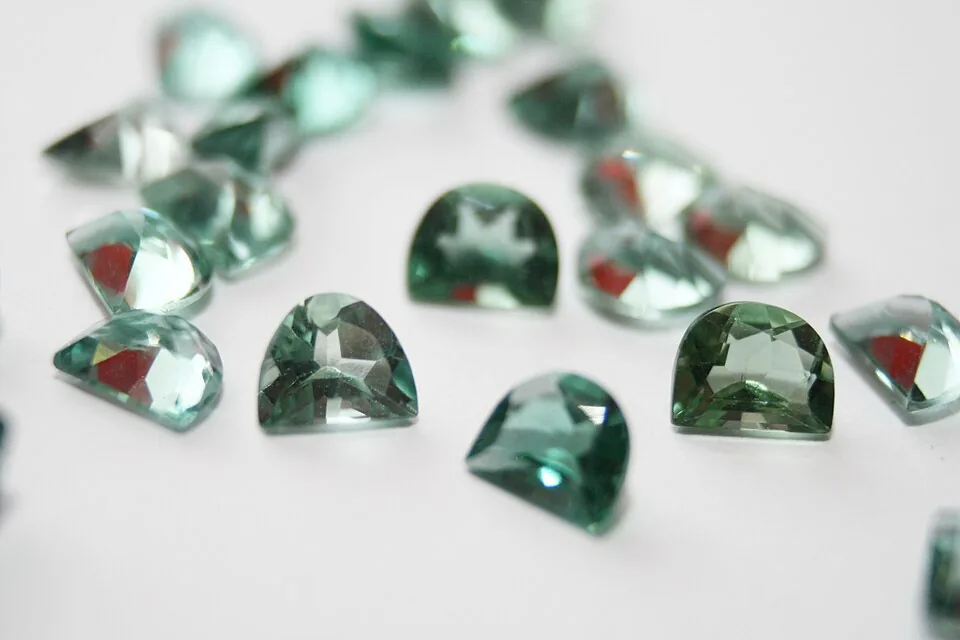
The main price drivers
| Factor | How it affects value |
|---|---|
| Colour | Visible, even green usually commands more interest than nearly colourless or grey material. |
| Cut | Precision, symmetry, brightness, and absence of a large window can matter greatly. |
| Clarity | Eye-clean stones are common enough that obvious distracting inclusions usually reduce appeal. |
| Size | Larger attractive stones may cost more in total, although price per carat is not always linear. |
| Disclosure | Clear treatment descriptions and credible documentation reduce uncertainty. |
| Jewelry construction | Gold content, labour, setting complexity, brand, warranty, and return policy can exceed the value of the stone. |
Loose stones and finished jewelry are different purchases
A loose-stone listing mainly reflects the gem, cutting, seller margin, and service. Finished jewelry adds metal value, design, setting labour, quality control, retail overhead, and sometimes brand premium. Comparing a loose stone with a finished ring is therefore misleading.
What you are really paying for
Stone qualityColour, cut, clarity and appearance.
Stone sizeCarat weight and face-up dimensions.
Jewelry settingMetal, craftsmanship and accent stones.
Seller premiumBrand, service, return policy and markup.
Common reasons buyers overpay
- Unsupported claims that all green amethyst is naturally rare.
- Photographs with boosted saturation or carefully selected lighting.
- Large carat weight paired with weak cutting and a transparent centre.
- Paying for a luxury brand while assuming the premium reflects gem rarity.
- No written treatment disclosure or return policy.
Important: A high asking price is not evidence of natural colour, origin, or rarity. Those claims require their own support.
How to compare two offers
- Compare similar stone sizes and shapes.
- Judge colour under neutral light.
- Inspect face-up brightness and windowing.
- Separate stone price from metal and workmanship.
- Compare disclosure, return rights, resizing, and warranty.
A better value question
Instead of asking only “Is this cheap?”, ask whether the stone is beautiful in ordinary light, well cut, accurately described, appropriately priced relative to comparable offers, and sold with reasonable protections.
Compare two offers without guessing
There is no single useful price-per-carat number for every green amethyst purchase. A loose stone and a finished ring can carry very different costs for reasons unrelated to the quartz itself.
| Compare | Why it matters |
|---|---|
| Stone dimensions, not carat alone | Two stones of similar weight can face up at noticeably different sizes because of cut depth and shape. |
| Cut quality | A well-cut stone may be a better buy than a heavier stone with obvious windowing. |
| Treatment disclosure | A routine treated stone should not be priced as exceptional natural-colour material without evidence. |
| Metal and setting | Metal weight, craftsmanship, accent stones, and setting complexity can dominate the final jewelry price. |
| Return policy and seller support | A slightly higher price can be rational when it includes a useful inspection period and reliable service. |
Better question than “Is this cheap?”Ask whether the price makes sense for the stone quality, setting, seller protections, and evidence behind unusual claims.
Related reading
Quality and value · Colour guide · Complete buying guide